
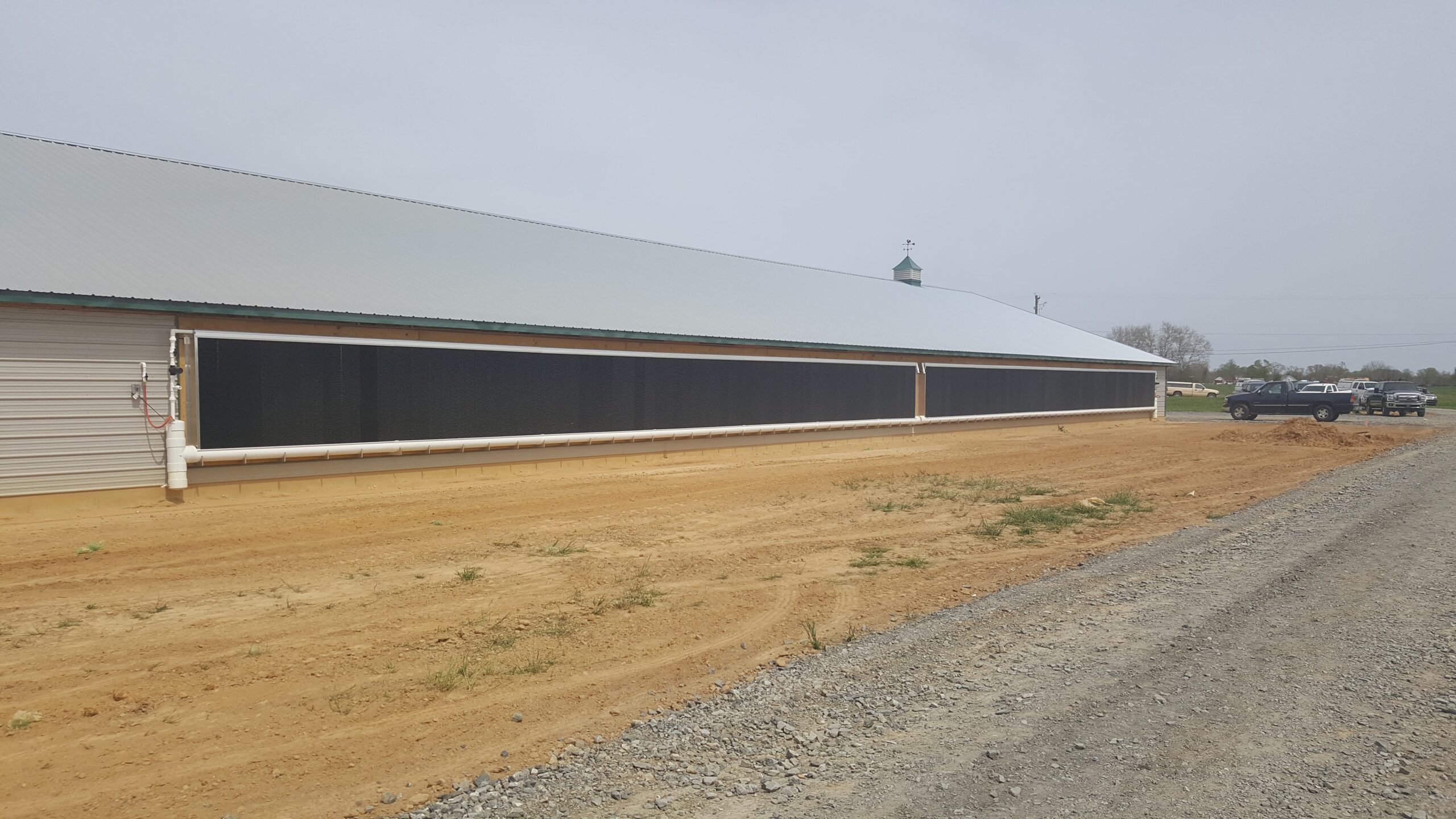
 The hottest part of the year can create many challenges for growers, especially those with larger birds. Air speed is the first defense we have against heat stress, but after the outside air gets above the skin temperature of the birds (usually 95°F/35°C), it actually speeds up the discomfort of the bird, rather than alleviating it. In those times, it’s necessary to use another form of heat removal, the most common being evaporative cooling. This is usually accomplished by either cool cell pad system or by misting or fogging system (cool cells are most common, so that’s what we’ll focus on). As water changes phases from liquid to gas (evaporates), it removes substantial amounts of heat from the environment. The key to an effective evaporative cooling program is understanding the relationship between relative humidity (Rh), temperature, and animal physiology. After that, understanding how to get the most out of your evaporative cooling system doesn’t hurt, either.
So, first things first. For every 1 gallon (3.79 liters) of water that is evaporated into the barn, 8700Btus of sensible heat are taken out of the air and converted to latent heat, or humidity. Roughly speaking, that means that for every 2.5% increase in relative humidity from evaporative cooling, we can remove 1°F (0.5°C) from the air temperature.
Birds need to be able to cool themselves through panting, which is severely limited if the Rh is above 85%. Because of this, we can’t just keep adding water to drop the temperature of the barn. If the Rh reaches 100%, despite the air being cooler, heat stressed birds won’t be able to cool themselves, and this results in bird losses.
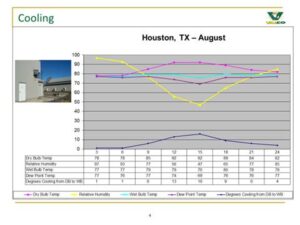 While it is true that where many barns are, it is hot and humid – it is rarely so at the same time. Usually, it is cooler and humid in the morning and evening, and hotter but drier in the midafternoon. And the crossing point is at 80°F. So, we have the 80-80 Rule – in most cases, if the air outside is 80°F (27°C) then the humidity is roughly 80%. This is because the ability of air to hold moisture (Rh) increases as the air warms up. So, in most cases (outside of summertime thunderstorms), when temperatures are above 80°F (27°C), you can safely run cool cells and still effectively evaporate moisture in the barn.
Some points to keep in mind:
Cool cells should not be operated 24-hours a day. In general, 10am – 10pm (or whenever the temperature is above 82°F (28°C)) is sufficient. Why?
- The pads should dry out at least once a day to prevent excessive algae growth.
- It is also helpful to overhang the cool pads to block sunlight – again to keep algae growth down
- Life of the pads and pump are decreased by over use.
- Litter cannot dry adequately in the barn with the excess moisture from pads running over night.
Fans should remain running until the house temperature has dropped low enough that heat stress is no longer a threat.
- This may not be until late at night or early morning. As the birds cool their appetites will increase, causing them to generate more heat before settling down. This is great for bird performance, but requires that fans stay on through the night.
The coolest, and dampest, air in the house is found right in front of the cool cells. As the air moves down the house, the temperature increases a few degrees, but the humidity drops by up to 20%, which will allow other moisture to evaporate into the air.
Learn more about poultry ventilation practices from the University of Georgia.



