
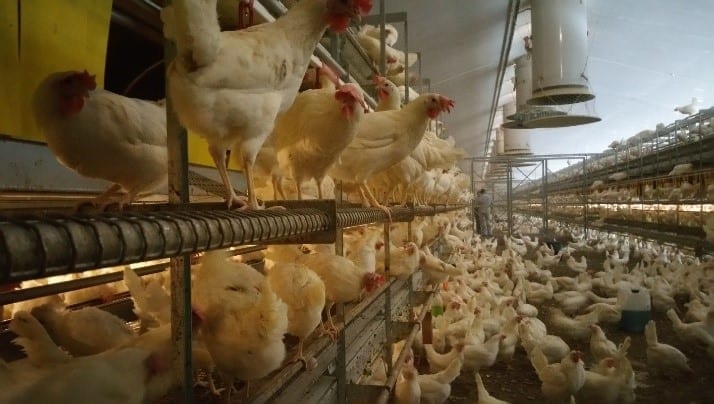
The switch to cage-free layer housing isn’t a new one, and definitely hasn’t been an easy one. We scoured the internet to compile a list of practices and recommendations to help you meet welfare standards and still maintain healthy, profitable flocks.
Feed
In cages, feed is wasted when birds overeat from boredom. In cage-free systems, birds have enough room to move about and keep themselves entertained, so feed is wasted primarily by  insufficient feeder design.
- Use a high-quality feeder that features a feed saving lip and anti-rake fins to reduce billing.
- Supply an adequate number of feeders or trough space so that lower ranking birds have ample opportunity to eat.
- Distribute feed at multiple locations to enhance flock uniformity.
- Run the feed belt eight or more times to reduce crowding at the feeders. Providing less feed more often can reduce feed wastage and maximizes feed intake.
Litter quality
It’s important to keep the litter dry to maintain low ammonia levels. In an aviary system, bird movement in higher tiers reduces manure accumulation in the litter since it is deposited on manure belts.
- Use an appropriate ventilation system to keep air fresh and ammonia levels low.
- Encourage hens to scratch and dust bathe – these activities rotate the litter. Increasing the attractiveness of the litter often directs pecking behavior at the ground to minimize aggressive behavior and injuries.
The ideal depth for litter is one inch – deep enough to dust bathe, shallow enough to dry quickly, and not deep enough for the hens to scratch it into a nest.
- Renew litter at least once during production and replace it when the litter becomes too wet or dirty.
- Litter should not excrete any liquid when a handful is squeezed.
Nests
All certifiers for cage-free laying hens agree that birds should have access to either individual nest boxes (1 per 5 hens) or a colony nesting systems that allows a minimum or 9 square feet per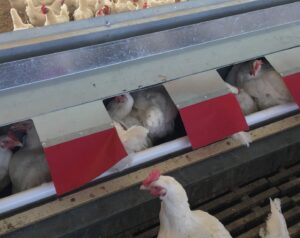 100 birds.
- Get hens accustomed to the nest box before lay commences to reduce floor eggs.
- Provide dividers to encourage even distribution along the house.
- Make nest boxes available at least two hours before barn lights turn on and close them at least one hour before lights out.
Perches
Perching is a high priority for hens. Subordinate hens use perches to escape aggressors, but it also helps to keep the hens from resting in the litter where they would be more susceptible to litter-borne bacteria or parasites.
- In an aviary system, situate perches at the top to encourage bird movement upwards.
- All cage-free certification programs require at least six inches of linear perch space per bird in all housing systems. Twenty percent of the total perch space must be raised a minimum of 16 inches above the adjacent floor height in all cage-free layer housing systems.
照明
The standard duration of light needed per day to reach maximum production is 16 hours. Light intensity is required to be a minimum of 10 Lux throughout the house, but optimal lighting of 30 Lux – or three foot-candles – at the feed troughs leads to more efficient production.
- Research has shown that sufficient lighting in the red spectrum – at around 2700-3000K – can lead to higher egg production.
- Bright lighting in the morning will increase bird activity and encourage entry into the nest box. Light intensity should be reduced after midday.
- Simulate dawn and dusk lighting to encourage birds to settle. If using an aviary system, dimming lights from the floor upwards encourages vertical movement in the house as the birds move to higher resting areas.



