
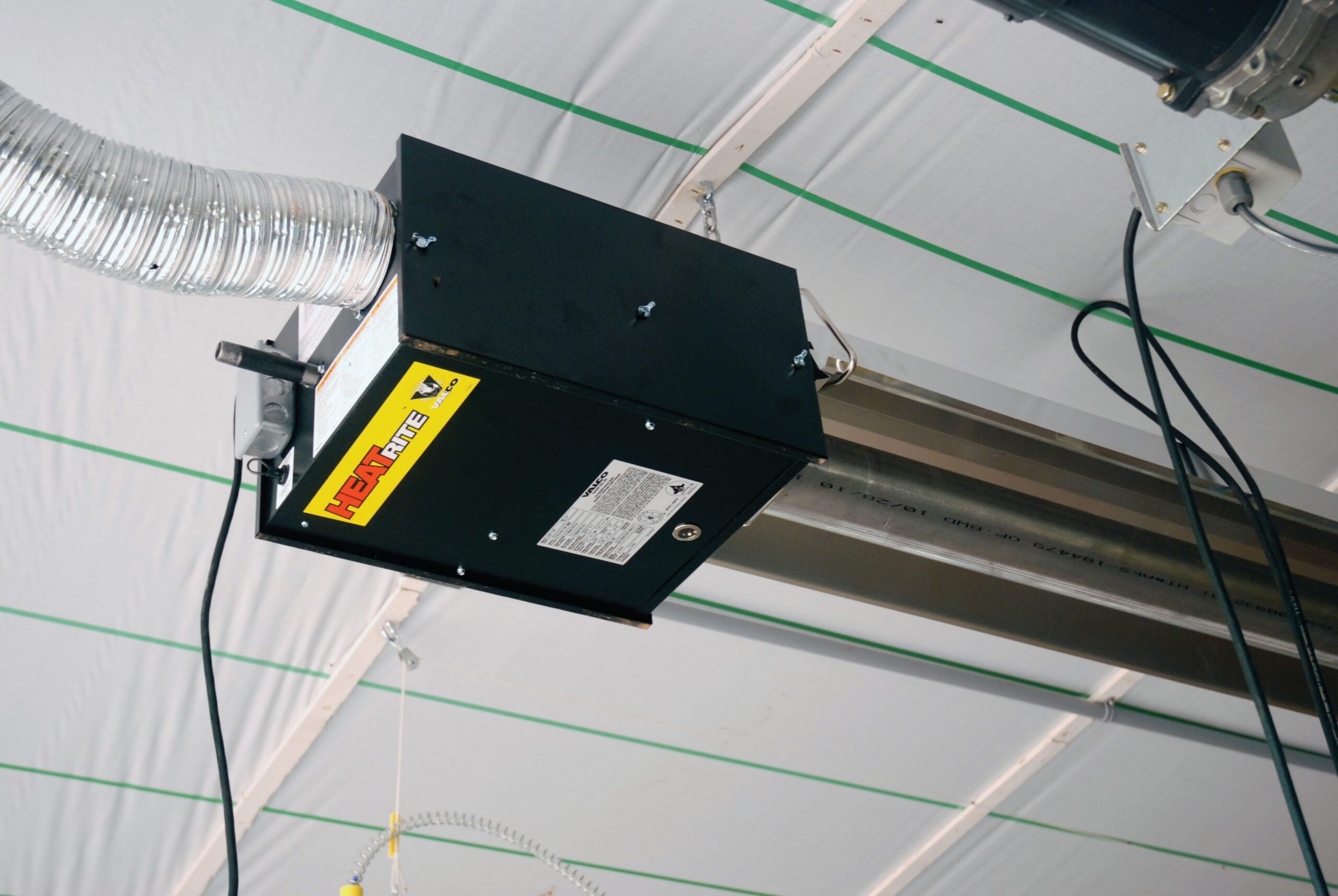
 Integrators and growers are continually evaluating and implementing automated technologies to produce birds more efficiently. The management of poultry houses during the early brooding stage of a chick’s life largely determines whether they will reach their full potential. Every hour that a chick’s environment is less than optimum reduces growth rate and increases feed conversion. Costs to both the grower and the integrator can be high if the brooding environment does not ensure that birds get off to a good, healthy start. Yet, heating and electricity costs continue to be large expenses encountered by growers. As a result, utilization of efficient heating methods can affect the bottom line of both growers and integrators. In recent years, gas-fired, low-intensity infrared heating has grown quickly in popularity over traditional heating systems in agricultural applications because energy savings of up to 50% can be achieved. Momentum for this technology increases as energy costs rise and integrators and growers spread the word.
Many gas-fired, low-intensity infrared heaters are listed with Canadian Standards Associations International (CSA) in North America, Europe and Asia. For a product to appear on these lists, and therefore qualify for the CSA claims, the product must meet the standards for consumer safety, health and environmental requirements and in some cases, energy saving criteria. The American Society of Heating, Refrigeration and Air Conditioning Engineers (ASHRAE) has also acknowledged the fuel saving characteristics of gas-fired, low-intensity heating over conventional heating systems in the HVAC Applications ASHRAE Handbook.
However, in the poultry industry, gas-fired, low-intensity infrared heating remains, to some, unfamiliar or misunderstood. When applied and installed properly, correctly maintained and utilized, integrators and growers can enjoy an improved growing environment and obtain significant fuel savings over traditional heating systems.
How does infrared heat work in a space?
Unlike air heaters, low-intensity infrared heat gently warms animals, people, floors and objects, NOT the air. These objects, in turn, absorb, and release heat in the space through re-radiation and convection. Since objects act as heat reservoirs, recovery time is much quicker, less energy is needed, thereby reducing fuel costs. This allows infrared heat to create a comfortable environment, even when air temperature is low.
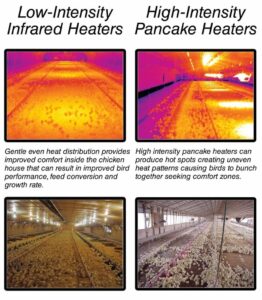 High-intensity infrared vs. low-intensity infrared
High-intensity heaters, identified sometimes as “Pancake Heaters” or by an open flame and high temperature (1,800°F) ceramic surface or grill, is more suitable to localized station heating or “spot” heating. In addition, since high-intensity heaters involve an open flame they consume valuable oxygen and add moisture to the house environment, requiring extra ventilation and causing the heaters to cycle on more frequently, resulting in increased energy costs.
Low-intensity equipment is identified by a flame contained within a tube or network of tubes at a reduced temperature (maximum 900° – 1,200° F). Although both forms of radiant heat produce radiant energy, the radiant energy produced by low-intensity heaters have a greater effect on energy absorption and heat distribution providing a much more effective and consistent heat pattern throughout the barn. High-intensity heaters have a tendency to create hot and cold spots throughout the barn, thus effecting the environment potentially reducing growth rate and overall chick performance.
Some benefits of low-intensity infrared heaters include:
Provides clean, comfortable, draft-free heat
Gently warms the space and its contents, rather than blowing dirty air around the barn.
Gives peace of mind
Field proven and installed in commercial/industrial buildings and poultry barns for decades.
Reduces energy consumption
Even floor temperatures in a short amount of time and greater comfort at lower temperatures compared to warm air heaters.
For more information, visit The Roberts Gordon website here.
Post by Dan Schindler of Roberts Gordon.
Subscribe to our blog!
[grid-1-3]
[email-subscribers namefield=”YES” desc=”” group=”Public”]
[/grid-1-3]



