
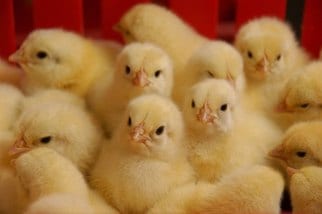
Chicks are dependent on their environment to survive the early days of life. Because they cannot regulate their own body temperature, they require a warm brood chamber and easy access to food and water.
The down feathers on chicks offer poor insulation and they will quickly lose heat through radiation (to the air), conduction (contact with the floor), and especially to convection(air movement). To keep warm, birds will huddle and eat more, which negatively impacts feed conversion and daily weight gain.
Carbon dioxide (from brooders or furnaces in proper working order), carbon monoxide (from brooders or furnaces NOT in proper working order), and ammonia (from damp, poorly maintained litter) can all cause severe health issues or death. These gases become a problem when the air exchange rate is too low. Minimum ventilation, if done right, provides good air quality at chick height without drafting the birds. Make sure the house is tight and that fans and inlets are in good working order to ensure good air quality for the chicks.
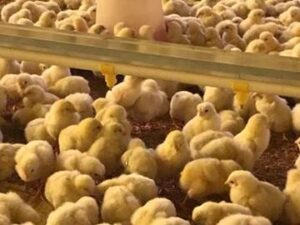
Water is the most necessary nutrient to new chicks. Water restriction in the first few days will negatively impact feed intake and conversion, resulting in low weights. Water lines should be full and available upon arrival to get chicks off to a good start.
Feeding preferences vary from grower to grower. Some prefer paper, others trays or started feeders. The most important thing, regardless of feeder type, is that there is always adequate feed. Couple this with sufficient lighting so they can learn where their food and drink are, and you’ll be off to a healthy, happy start.
Use the pre-placement checklist below to help you prepare.
 Pre-placement Checklist:
- Check Equipment
- Drinkers
- Cleaned
- Flushed
- Filled and actuated so pin holds a drop of water
- Drop of water placed at chick eye height
- Drinkers
- Feeders
- Cleaned & dried
- Paper, trays or supplemental feeders placed
- Feeders flooded and full
- Heaters
- Cleaned and dust-free
- All gas lines and ignitions in good working order
- Hung at proper height
- Ventilation
- Shutters, blades, and cones cleaned
- Belts fit and fixed
- Bearings greased if necessary
- Check sensors
- Calibrated for accuracy
- Temperature sensors placed in brood chamber at just above bird height — raise as birds grow
- Floor temperature
- Begin minimum ventilation simultaneously with pre-heating
- Start pre-heating ~48 hours before chick placement — earlier if using space heaters (~72 hours before chick arrival), shorter if using radiant heaters (24-48 hours)
- Warmed and stabilized at least 24 hours before placement to 105F (using radiant heat)



