
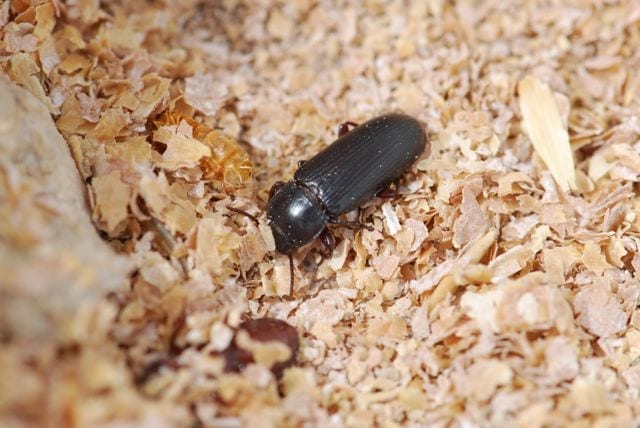
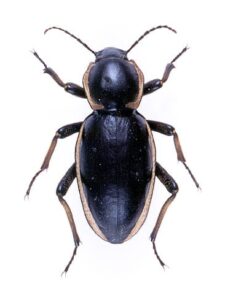
 Litter beetles. Darkling beetles. Black beetles. Whatever you call them, you know what I’m talking about. They disturb chicks, harbor disease, damage houses, steal food, and cut into profits. They’re everywhere. In every flock. In every house. You know why? They love it.
Seriously. They prefer temperatures of 75-95°F. They prefer 12% moisture but will tolerate more. They’re nocturnal. And they’re attracted to ammonia. Sound familiar?
Litter beetles create all sorts of losses. A typical infestation can result in a 1 point loss in feed conversion alone just from beetles eating the poultry feed. They decrease the birds’ feed efficiency by pestering them and making them move around more. They kill weaker chicks when they are moisture deprived by feeding off them. They transmit diseases like Marek’s, E.coli, and Necrotic Enteritis resulting in health issues or greater mortality. They burrow in to the wood and insulation of the poultry house and cause air leaks, cracks, and holes in the building that will need to be repaired every few years, and that’s not even accounting for the heating and ventilation losses experienced in the meantime.
We can’t afford all those losses. You know what loss we can afford? The loss of these pesky beetles.
Let’s look at the beetles lifespan to get an idea of what we’re up against.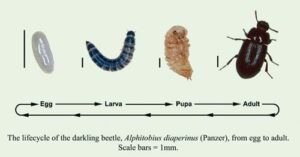
- A mature female lays 200-400 eggs every 1-5 days.
- Eggs hatch in 4-7 days.
- Larva go through several growth stages over 35-65 days.
- Larva find a dark area to pupate (sidewalls, insulation). Pupa stage lasts 4-7 days.
- Beetles emerge and reach sexual maturity in 6-7 days.
- Adult beetles live up to 1 year.
Given all this, a typical infestation could have 1000 litter beetles per square yard. That’s around 2 million beetles in a 40-500 house. That’s way too may beetles, and that’s on the low side.
Luckily, we have insecticides.
Some are safe to use with animals in the house. They’re mostly organic and can be consumed by your birds, because, naturally, the chickens will also be eating the beetles. They hate them as much as you do. Harsher insecticides can only be used between flocks. These are commonly effective against both adult and larval stages and have a longer life span, killing off more of the population.
Some tips to using insecticides:
- ALWAYS FOLLOW MANUFACTURER DIRECTIONS.
- Rotate between different classes of chemicals at least every 2 flocks. Using one product too often results in resistance, and the product will become ineffective.
- Apply insecticide using as little water as possible. It needs to be strongly concentrated to be effective.
- Spray in a fine mist instead of a coarse spray application.
- Apply insecticide in a 3ft wide band under feed lines and along the walls, including the footing, and up 2 feet from there.
- Apply insecticide to the top of the litter after caking out or on top of fresh shavings after clean out.
- Apply insecticide to any litter stored in the stacking shed to prevent beetles from migrating back to the barns.
- If windrowing, apply insecticide along the top of the windrow and along the floor and sides so that beetles are killed as they move to escape the heat. Make sure this is done within 48 hours of bird removal; beetles will move into the ground or sidewalls after birds are gone and house conditions change.
There are additional practices to help control beetles. Clean up feed spills and remove mortalities daily. Beetles don’t like temperatures below 40°F, so you can leave the house open between flocks during winter to help drive beetles off.
A healthy combination of good biosecurity and practical chemical application can help you keep the beetle population under control. For more advice on controlling litter beetles, check this out.



